


Tax on Gifts in India
Understanding gift tax in India is essential for managing your finances. Gifts are now taxed under the Income Tax Act, 1961. This ensures that you know what you receive is taxed correctly.
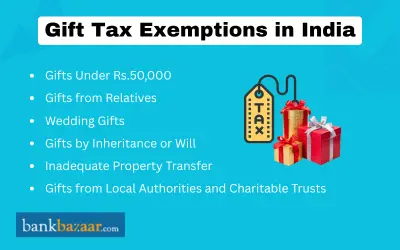
You can receive gifts worth up to Rs.50,000 in a financial year from non-relatives without any tax. If the value exceeds this limit, the entire gift amount becomes part of your taxable income. However, gifts from specific relatives or for certain occasions are completely tax-free. Knowing these rules is crucial for your financial planning.
What is Gift Tax?
A gift refers to the transfer of movable or immovable property, or any valuable item, from one person or organization to another without receiving any monetary compensation in return.
What Is Considered a Gift?
Under the Income Tax Act, a gift is any asset you receive without payment. This includes:
- Money: Cash, cheques, or electronic fund transfers.
- Immovable Property: Land or buildings received without consideration.
- Movable Property: Assets like shares, jewellery, drawings, and paintings.
How Gifts Are Valued and Taxed
The tax on a gift depends on its type and value. You must report any taxable gift under the head 'Income from Other Sources' in your Income Tax Return (ITR).
Type of Gift | When It Becomes Taxable | Taxable Amount |
Money | If the total amount from non-relatives exceeds Rs. 50,000 in a year. | The entire amount received. |
Immovable Property | If the stamp duty value exceeds Rs. 50,000. | The full stamp duty value. |
Movable Property | If the aggregate fair market value exceeds Rs. 50,000. | The full fair market value. |
Gifts from Relatives: Always Tax-Free
You do not need to pay tax on any gift you receive from a relative. The Income Tax Act specifies who qualifies as a relative for this exemption.
- Your Spouse
- Your Brother or Sister
- Your Spouse's Brother or Sister
- Your Parent's Brother or Sister
- Your Direct Ancestors (Parents, Grandparents)
- Your Direct Descendants (Children, Grandchildren)
- The Spouse of any of the individuals listed above
Tax-Free Gifts for Specific Occasions
Certain gifts are always tax-exempt, regardless of who gives them to you.
- On the occasion of your marriage: All gifts received at the time of marriage are tax-free.
- By will or inheritance: Any asset you inherit is not subject to gift tax.
- From a local authority: Such as a Municipal Corporation or a District Board.
- From a registered charitable or religious trust.
Gift Tax Rules for Non-Resident Indians (NRIs)
The rules for gifts can differ for Non-Resident Indians (NRIs). The taxability depends on the residential status of both the giver and the receiver.
- A gift from one NRI to another NRI is not taxed in India.
- Gifts from a resident Indian to an NRI are taxed in the hands of the NRI if the amount is over Rs. 50,000 and the gift is not from a specified relative.
Understanding Clubbing of Income Provisions
If you gift an asset to your spouse or minor child and they earn income from it, that income may be taxed in your hands. This is called the clubbing of income. For example, if you gift Rs. 5,00,000 to your spouse, who then invests it and earns interest, that interest income will be added to your total income for tax purposes.
FAQs on Gift Tax
1.Do I have to pay tax on a gift from a friend?
Yes, if the value of the gift from a friend is more than Rs. 50,000 in a financial year, the entire amount becomes taxable for you.
2.Are gifts received on a birthday or anniversary tax-free?
No, these occasions are not given special exemption. Gifts from non-relatives on these days are taxable if they cross the Rs. 50,000 limit.
3.Is a gift of a car taxable?
No, a motor vehicle is not included in the definition of movable property for gift tax purposes, so its value is not taxed in your hands.
4.How are gifts from an employer treated?
Yes, if your employer gives you a gift with a value over Rs. 5,000, it is considered a perquisite and will be taxed as part of your salary income.
5.What about gifts of life insurance policies?
Yes, if you receive a life insurance policy as a gift from a non-relative and the premium payable exceeds Rs. 50,000, the maturity proceeds could become taxable.

Disclaimer
Credit Card:
Credit Score:
Personal Loan:
Home Loan:
Fixed Deposit:


Copyright © 2026 BankBazaar.com.