


Personal Loan Interest Rates
Personal loan interest rates in India range from 8.75% to 24% p.a., depending on your credit score, income, and employment profile. Compare the latest rates across 14+ banks and NBFCs to find the best personal loan that fits your financial needs. Apply online for instant approval and fund your plans without delay.

Personal Loan Interest Rate (August 2026) - Lowest Interest Rates
The personal loan interest rates of various Indian banks are listed in the table below:
Bank Name | Interest Rate (p.a.) | Processing Fee |
10.00% p.a. to 15.00% p.a. | Up to 1.50% | |
9.99% p.a. to 24.00% p.a. | Rs. 6,500 + GST | |
9.99% p.a. to 16.50% p.a. | Up to 2% | |
8.75% p.a. to 21.55% p.a. | Up to 2% of loan amount | |
10.99% p.a. onwards | Up to 5% | |
9.99% onwards | 0% to 3.5% of loan amount | |
12% p.a. onwards | Up to 3.5% onwards | |
10.85% to 21% p.a. | Up to 2.5% | |
10.15% p.a. onwards | Up to 2% | |
10.85% p.a. onwards | 1% of loan amount, subject to a minimum of Rs.2,500 up to Rs.15,000 | |
Floating: Starting from 10.25% p.a. Fixed: Starting from 11.25% p.a. | 0.35% of loan amount | |
11.00% to 15.50% p.a. | 1% | |
8.75% p.a. | Up to 1% |
Note: Interest rates mentioned above are updated on 4 August 2026. Please note that GST will be charged on applicable processing fees. Rates are subject to change based on the RBI's monetary policy and individual creditworthiness.
How to Get the Lowest Interest Rate on a Personal Loan?
If you are looking to apply for a personal loan, here are a few tips that will help you avail a cheapest rate of interest:
- Improve Your Credit Score: A high credit score indicates that you are creditworthy. Banks and financial institutions offer the lowest personal loan interest rates to applicants who have a high credit score. Thus, you should check your credit score before applying for a personal loan. If your credit score is less than 750, you should look for ways to improve it. There are more chances of you getting a personal loan at a low interest if your credit score is over 750.
- Avoid Missing Repayments: If you miss a loan or credit card repayment, your credit score may be adversely affected. Loan providers usually take your repayment history into account before deciding the personal loan interest rates. Those who have paid their past EMIs and credit card bills on time are likely to be charged a lower interest.
- Keep an Eye Out for Offers: Banks and financial institutions usually offer special interest rates for a limited period of time during festive occasions. If you apply for a loan while such an offer is running, you may be offered a lower rate of interest.
- Compare Interest Rates: Before applying to a particular bank for a personal loan, it is necessary to compare the personal loan interest rates charged by various NBFCs and banks. This will help you avail a personal loan at a competitive interest rate.
- Negotiate with the Lender: If you are an existing customer of a bank or have a good relationship with the loan provider, you can negotiate for the lowest interest rate. When doing this, it is advisable to submit a formal written request to the loan provider.
Factors that Affect Personal Loan Interest Rates
- Income: Loan providers take the applicant's income into account when deciding the interest rate. Individuals who have a high income pose a lower risk to the bank and, thus, might be offered a lower interest rate. On the other hand, those with lower annual incomes may have to pay a higher interest rate.
- Employer Details: If you work for a reputed organisation, the bank/financial institution is more likely to offer you a lower rate of interest.
- Nature of Employment: Loan providers may offer different interest rates to applicants based on whether they are self-employed or salaried.
- Age: The age of the applicant can also have an impact on the interest rate quoted by the loan provider. Individuals who are nearing retirement age may be charged a higher interest rate.
- Relationship with the Loan Provider: Existing customers of the bank/financial institution may be offered a lower rate of interest at the time of applying for a personal loan, provided they have a good relationship with the loan provider. This is, however, at the discretion of the bank and not all existing customers will be offered a preferential interest rate.
Fixed Interest Rates vs Floating Interest Rates: Which is better?
Feature | Fixed Rate | Floating Rate |
Interest Movement | Constant | Market-linked, may vary |
EMI Stability | Remains the same | Can increase or decrease |
Prepayment Charges | Usually applicable | Often waived |
MCLR Linkage | Not linked | Linked to MCLR |
The benefit of opting for a fixed interest rate is that you know exactly how much you will be charged during the loan tenure. Thus, those who wish to plan their finances in advance can opt for a fixed interest rate.
If you, however, don't mind a fluctuating interest rate, you can opt for a floating/variable interest rate. The benefit of opting for a variable interest rate is that your repayment amount will reduce when the interest rate is low.
How Reducing Balance Interest Rates Work in Personal Loans
When you avail a personal loan at a flat interest rate, the interest is calculated on the entire loan amount throughout the loan repayment period. In comparison, if you avail a loan at a reducing interest rate/reducing balance rate structure, the interest is only calculated on the outstanding loan amount. Thus, in this case, when you make a monthly repayment, the interest for the remainder of the loan tenure will be calculated on the outstanding loan balance.
Important Considerations Before Choosing a Personal Loan Interest Rate
While selecting a personal loan with a low interest rate, there are a few other things that you should consider:
- Processing Fee: Loan providers levy a one-time charge known as the processing fee, which can increase the cost of the loan. Even if you are charged a low interest, it is important to check and compare the processing fee charged by different lenders.
- Pre-Closure Charges: Certain banks may charge you a pre-closure fee if you repay the outstanding loan balance before the completion of the loan repayment tenure. Make sure to check if the bank/financial institution that you are applying to levies a pre-closure charge.
- Customer Service: In order to have good borrowing experience, it is necessary to apply to a lender that offers good customer service. Before submitting your loan application, you should check the customer care channels that are available and how prompt the lender is in providing you assistance when required.
- Eligibility Criteria: While the bank or financial institution may offer personal loans at low interest rates, you should make it a point to check if you meet the eligibility criteria specified by the lender. To this end, you should ensure that you check if your income meets the set limit and if you meet the age requirements specified.
- Loan Disbursal Time: If you are looking to take a personal loan due to an emergency, it is important to take the loan disbursal time into account. A number of leading banks and financial institutions disburse the loan amount within a matter of seconds.
- Other Charges: While the lender may charge you a slightly higher interest rate, you may be able to save on the overall cost of the loan if the processing fee, default charges, pre-payment fee, Loan Cancellation Charges, Check/EMI bounce charges, Instrument return charges, Stamp Duty Charges, Duplicate statement issuance charges, swap charges, Duplicate Amortization schedule issuance charges, etc., are low. Thus, make sure you compare the various charges levied by the lender before applying for a personal loan.
- Discounts: Although the bank/financial institution may have specified a high interest rate, you can try to negotiate with the bank for the lowest interest rate. Many times, lenders will give a discount to existing customers and to those who have maintained a healthy relationship with them.
- Special Offers: Certain lenders may charge you a lower interest rate during festive occasions.
*Some loan providers do charge a comparatively higher interest rate; however, you should take certain other factors into account before making a decision.
How to Calculate EMI on Your Personal Loan?
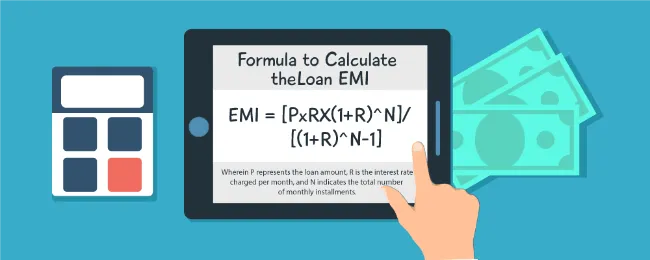
You can use the Personal Loan EMI calculator offered by BankBazaar to calculate the EMI you will have to pay. You will have to enter the loan amount, repayment tenure, interest rate, and the processing fee to know the EMI you will pay on a monthly basis.
Formula to Calculate Personal Loan EMI
EMI = [PxRX(1+R)^N]/[(1+R)^N-1], wherein P represents the loan amount, R is the interest rate charged per month, and N indicates the total number of monthly installments.
Additional Charges You Should Know Before Taking a Personal Loan
Apart from your loan rate, there are a few other charges that form a part of your cost. These include the following:
- Processing charges - for processing your application
- Verification charges - for verifying your background and other parameters
- Government taxes - for example, GST
- Late payment fees - if you don't pay your EMIs on time
- Prepayment fees - if you want to prepay a part of your loan
- Foreclosure fees - if you want to close your loan ahead of schedule
How Lenders Calculate Prepayment Charges on Personal Loans
The prepayment fee is usually calculated in two ways:
- As a percentage of the amount you want to prepay, or
- As a percentage of the principal amount outstanding at the time of prepayment.
Some lenders may charge you a fixed fee for this facility.



FAQs on Personal Loan Interest Rates
1.What factors determine my personal loan interest rate?
Your personal loan interest rate is determined by your credit score, income level, employment type, age, and relationship with the lender. Borrowers with credit scores above 750 typically qualify for the lowest personal loan interest rates, whilst those with lower scores may face higher rates.
2.How can I get the best personal loan interest rate?
To secure the best personal loan interest rate, improve your credit score to 750+, maintain a good repayment history, have steady income, and negotiate with your existing lender for preferential rates. Comparing personal loan interest rates across multiple banks also helps you find competitive offers.
3.What is the difference between fixed and floating personal loan interest rates?
Fixed personal loan interest rates remain constant throughout the loan tenure, making repayment predictable. Floating personal loan interest rates change with the market and RBI's MCLR, which can increase or decrease your EMI over time.
4.Does my credit score affect personal loan interest rates?
Yes, your credit score significantly impacts your personal loan interest rate. A higher credit score (750+) demonstrates financial responsibility and typically qualifies you for lower personal loan interest rates, whilst scores below 750 may result in higher rates or loan rejection.
5.Can I negotiate personal loan interest rates with my bank?
Yes, if you are an existing customer with a good relationship with your bank, you can negotiate for lower personal loan interest rates. Many lenders offer relationship discounts on personal loan interest rates to long-standing customers.
6.What is the reducing balance method for calculating personal loan interest?
Under the reducing balance method, personal loan interest is calculated only on the outstanding loan amount, not the original principal. This means as you repay your personal loan, the interest for the remaining tenure decreases.
7.Do personal loan interest rates vary by employment type?
Yes, personal loan interest rates vary based on employment type. Salaried employees often qualify for better personal loan interest rates than self-employed individuals, as they have more stable, verifiable income.
8.How often do personal loan interest rates change?
Floating personal loan interest rates change each time the RBI adjusts the repo rate. Fixed personal loan interest rates remain unchanged throughout the loan tenure, providing certainty in your monthly repayments.
9.What is an MCLR and how does it affect personal loan interest rates?
MCLR (Marginal Cost of Lending Rate) is the minimum interest rate banks can charge. Floating personal loan interest rates are linked to MCLR, so when RBI changes the repo rate, MCLR changes and your personal loan interest rate adjusts accordingly.
10.What is the average personal loan interest rate in India?
Personal loan interest rates in India typically range from 8.75% to 24% p.a., depending on the lender and your creditworthiness. Most banks start their personal loan interest rates between 9% and 10% p.a. for qualified borrowers.
11.How does debt-to-income ratio affect personal loan interest rates?
Your debt-to-income ratio shows lenders how much of your income goes towards debt repayment. A lower ratio means you can service more debt, qualifying you for better personal loan interest rates, whilst a higher ratio may result in higher rates or denial.
12.Can I switch from a fixed to floating personal loan interest rate?
Switching personal loan interest rates from fixed to floating depends on your lender's policies. Some banks allow this conversion, whilst others do not. Check with your bank about their personal loan interest rate conversion policy.
13.What are prepayment charges on personal loans?
Prepayment charges are fees levied when you repay your personal loan before the agreed tenure ends. These charges are typically calculated as a percentage of the prepaid amount or outstanding principal, though some lenders waive personal loan prepayment charges for floating rate loans.
14.How is personal loan EMI calculated?
Personal loan EMI is calculated using the formula: EMI = [P×R×(1+R)^N]/[(1+R)^N-1], where P is the loan amount, R is the monthly interest rate, and N is the number of monthly instalments. You can use the BankBazaar EMI calculator for quick calculations.
15.Are personal loan interest rates the same for all applicants?
No, personal loan interest rates vary for each applicant based on individual factors like credit score, income, employment status, and loan amount. Two borrowers may receive different personal loan interest rates from the same bank based on their creditworthiness.
16.Should I choose a personal loan based only on interest rate?
No, whilst interest rate matters, you should also consider processing fees, prepayment charges, customer service, disbursal speed, and eligibility criteria when comparing personal loans. The lowest personal loan interest rate may not always represent the best overall loan offer.
17.How do banks benefit from offering lower personal loan interest rates?
Banks offer competitive personal loan interest rates to attract creditworthy borrowers and increase loan volumes. By offering lower personal loan interest rates to qualifying applicants, banks reduce default risk whilst building customer relationships.
18.What happens to my personal loan interest rate if I miss a payment?
Missing personal loan repayments can trigger late fees and negatively impact your credit score, potentially leading to higher personal loan interest rates in future applications. Some lenders may also increase your current rate after sustained payment defaults.

Karishma VP has over a decade of experience in content writing which includes over five years specializing in personal finance. Her career in BankBazaar has given her the opportunity to write on a wide variety of financial products ranging from credit cards and home loans to insurance policies and government schemes. She believes that an understanding of personal finance is an important step to leading an independent, empowered life. This has led to her being passionate about learning more about the BFSI sector and writing about it as clearly, concisely, and accurately as possible to make it accessible to a larger audience through BankBazaar.
Personal Loans by Bank
- SBI Personal Loan
- HDFC Personal Loan
- IDFC First Personal Loan
- Kotak Personal Loan
- Axis Personal Loan
- Yes Bank Personal Loan
- IDBI Personal Loan
- Indusind Personal Loan
- Standard Chartered Personal Loan
- RBL Personal Loan
- Indian Bank Personal Loan
- Canara Bank Personal Loan
- Bank of Baroda Personal Loan
- Bank of India Personal Loan
- Central Bank of India Personal Loan
- Punjab National Bank Personal Loan
- Union Bank Personal Loan
- IOB Personal Loan
- Bank of Maharashtra Personal loan
- UCO Bank Personal Loan
- Punjab and Sind Bank Personal Loan
Personal Loan Eligibility by Banks
- SBI Personal Loan Eligibility
- HDFC Personal Loan Eligibility
- Kotak Personal Loan Eligibility
- Axis Bank Personal Loan Eligibility
- SCB Personal Loan Eligibility
- Tata Capital Personal Loan Eligibility
- IDBI Bank Personal Loan Eligibility
- Indusind Personal Loan Eligibility
- RBL Personal Loan Eligibility
- Yes Bank Personal Loan Eligibility
- Canara Bank Personal Loan Eligibility
- Bank of Baroda Personal Loan Eligibility
- PNB Personal Loan Eligibility
- IOB Personal Loan Eligibility
- Union Bank Personal Loan Eligibility
- Central Bank of India Personal Loan Eligibility
- UCO Bank Personal Loan Eligibility
- Bank of India Personal Loan Eligibility
- Bank of Maharashtra Personal Loan Eligibility
Personal Loan Interest Rates by Bank
- HDFC Personal Loan Interest Rates
- Kotak Personal Loan Interest Rates
- SBI Personal Loan Interest Rates
- Axis Bank Personal Loan Interest Rates
- SCB Personal Loan Interest rates
- Tata Capital Personal Loan Interest rates
- RBL Bank Personal Loan Interest rates
- YES Bank Personal Loan Interest rates
- Canara Bank Personal Loan Interest Rates
- Bank of Baroda Personal Loan Interest Rates
- Punjab National Bank Personal Loan Interest rates
Personal Loan EMI Calculator by Bank
- HDFC Personal Loan EMI Calculator
- AXIS Bank Personal Loan EMI Calculator
- Kotak Personal Loan EMI Calculator
- SCB Personal Loan EMI Calculator
- SBI Personal Loan EMI Calculator
- TATA Capital Personal Loan EMI Calculator
- YES Bank Personal Loan EMI Calculator
- PNB Personal Loan EMI Calculator
- Canara Bank Personal Loan EMI Calculator
Personal Loan Customer Care by Bank
- SBI Personal Loan Customer Care
- HDFC Personal Loan Customer Care
- IDFC First Personal Loan Customer Care
- Kotak Personal Loan Customer Care
- Axis Bank Personal Loan Customer Care
- TATA Capital Personal Loan Customer Care
- Shriram Finance Personal Loan Customer Care
- Indusind Personal Loan Customer Care
- Indiabulls Personal Loan Customer Care
- BOB Personal Loan Customer Care
- IIFL Bank Personal Loan Customer Care
- Yes Bank Personal Loan Customer Care
- RBL Personal Loan Customer Care
- Punjab National Personal Loan Customer Care
- Canara Personal Loan Customer Care
Personal Loan Status Track by Bank
- HDFC Bank Personal Loan Status
- IDFC First Personal Loan Status
- Yes Bank Personal Loan Status
- Tata Capital Personal Loan Status
- Axis Bank Personal Loan Status
- KOTAK Bank Personal Loan Status
- IndusInd Personal Loan Status
- SBI Bank Personal Loan Status
- PNB Bank Personal Loan Status
- Canara Bank Personal Loan Status
- Mahindra Finance Personal Loan Status
Personal Loan Articles
- Top Personal loan Finance Companies
- Personal Loan without Documents
- Personal Loan Verification Process
- Personal Loan Disbursal Process
- Personal Loan Preclosure Procedure
- Personal Loan for NRI
- Personal Loan Prepayment
- Pre Approved Personal Loan
- Personal Loan for Non Listed Companies
- Personal Loans by Private Sector Banks
- Microfinance Institutions
- Financial Inclusion Schemes in India
- Process of Bank Guarantee
- Promissory Notes
- Credit Appraisal
- Project Financing
- Statutory Liquidity Ratio
- Marginal Standing Facility
- Personal Loan Preclosure Calculator
- HDFC Bank Personal Loan Preclosure
Other Loans
- Mudra Loan
- Mortgage Loan
- MSME Loan
- Buy Now Pay Later
- Instant Loan
- NABARD
- SIDBI
- SKS Microfinance
- Agriculture Loan
- Business Start up Loan
- Marksheet Loan
- Loans For Unemployed
- Personal Loan for Low Salary
- Personal Loans by NBFCs
- Personal Loan for Govt Employees
- Personal Loan on Aadhar Card
- Personal Loan Insurance Plans
- Personal Loan Top Up
- Personal Loan for Salaried Employees
- Personal Loan for Self Employed

Disclaimer
Credit Card:
Credit Score:
Personal Loan:
Home Loan:
Fixed Deposit:


Copyright © 2026 BankBazaar.com.