


Top NRE Fixed Deposit Plans 2026
An NRE Fixed Deposit lets Non-Resident Indians invest foreign earnings in India. Interest is exempt from tax in India for those who qualify as a person resident outside India under FEMA, and both principal and interest are freely repatriable, subject to RBI/FEMA regulations. Opened through an NRE account, it suits eligible NRIs and Persons of Indian Origin seeking secure returns, with tenures from 1 to 10 years and rates that vary by bank.
With so many Indians now living and working abroad, Non-Resident External (NRE) deposits have become popular. So what exactly is an NRE fixed deposit? NRE fixed deposits are similar to regular term deposits with NRIs using NRE accounts to open fixed deposits. The accounts can be opened by all NRIs and are virtually tax-free.
NRE Fixed Deposit Interest Rates
The interest rates offered on NRE fixed deposit by banks for deposits less than Rs.3 crore are as follows:
Bank | 1 Year (p.a.) | More than 1 Year to 3 Years (p.a.) | More than 3 Years to 5 Years (p.a.) | More than 5 Years to 10 Years (p.a.) |
Union Bank of India | 6.20% | 6.10% - 6.65% | 6.00% | 6.00% |
Punjab National Bank | 6.25% | 6.30% - 6.60% | 6.35% | 6.00% |
Punjab and Sind Bank | 5.85% | 5.60% - 5.95% | 5.85% | - |
IDBI Bank | 6.20% | 6.25% - 6.50% | 6.35% | 5.90% - 5.95% |
Canara Bank | 6.20% | 5.50% - 6.20% | 5.00% | 5.00% |
Indian Overseas Bank | 6.50% | 6.40% - 6.60% | 6.10% | 6.10% |
UCO Bank | 6.10% | 6.00% - 6.45% | 6.00% | 6.00% |
Bank of India | 6.25% | 6.30% - 6.60% | 6.25% | 6.00% |
Bank of Baroda | 6.30% | 6.30% | 6.35% | 6.05% |
Indian Bank | 6.10% p.a. | 6.15% - 6.20% | 6.05% | 6.00% |
State Bank of India | 6.25% | 6.15% - 6.25% | 6.00% | 6.05% |
Bank of Maharashtra | 6.40% | 5.25% - 6.15% | 5.00% | 5.00% |
Karur Vysya Bank | 6.55% | 6.55% | 6.55% | 6.25% p.a. |
DCB Bank | 6.90% | 6.90% - 7.50% | 7.00% - 7.10% | 7.00% |
South Indian Bank | 6.25% | 5.85% - 6.80% | 6.35% | 5.70% - 6.00% |
City Union Bank | 6.65% | 6.50% - 7.25% | 6.25% p.a. | 6.25% p.a. |
Federal Bank | 6.25% | 6.40% - 6.65% | 6.50% - 6.70% | 6.40% |
Axis Bank | 6.25% | 6.25% - 6.50% | 6.50% | 6.50% |
Tamilnad Mercantile Bank | 6.80% | 6.60% - 7.25% | 6.70% | 6.70% |
Kotak Mahindra Bank | 6.35% | 6.45% - 6.80% | 6.40% | 6.25% |
J&K Bank | 6.55% | 6.60% - 6.75% | 6.80% | 6.85% |
Karnataka Bank | 6.50% | 6.15% - 7.00% | 6.15% | 5.50% |
Dhanlaxmi Bank | 6.25% | 6.25% - 6.50% | 6.50% | 6.60% p.a. |
Thane Janata Sahakari Bank | 6.75% | 6.75% - 7.00% | 6.65% | 6.65% |
Saraswat Co-operative Bank | 7.15% p.a. | 7.00% p.a. - 7.50 % p.a. | 6.75% p.a. | 6.75% p.a. |
Abhyudaya Co-operative Bank | 6.15% | 6.35% - 6.55% | 6.15% | 5.90% |
Note: Interest rates updated on 19 August 2026.
Eligibility criteria for NRE fixed deposits
To open an NRE fixed deposit, one needs to fulfil the following criteria:
- The individual needs to be a Non-Resident Indian (NRI) or a Person of Indian Origin (PIO)
- They need to have NRE accounts
NRE deposits are governed by the Reserve Bank of India's Foreign Exchange Management Act (FEMA) regulations, which set out the rules for opening and maintaining NRE accounts and deposits.
Documents required to open NRE deposits
To open an NRE deposit, an individual needs to submit documents like:
- Passport
- Valid work visa
- Address proof
Features of NRE Deposits
NRE deposits are laced with a variety of features. Some of them are mentioned below:
- Money can be deposited in Indian rupees
- The account can be closed at any time after it is opened
- Offers flexible tenures that may range from 1 year to 10 years
- Auto-renewal facilities are offered by banks where the FD renews itself once it matures.
- Some banks may even allow loans against NRE deposits
- Some banks allow up to 90% overdrafts on NRE deposits
- Some banks also allow NRE deposits to be held jointly
- Banks may even offer tax-saver fixed deposits to NRIs allowing them to claim tax benefits under Section 80C of the IT Act
- Banks have stipulations on the minimum and maximum amounts that one can deposit
- As interest on NRE deposits is exempt from tax in India, no TDS (Tax Deducted at Source) is deducted on it, unlike on NRO deposits.
Benefits of NRE Deposits
When an NRI opens an NRE deposit, he/she is entitled to certain benefits. Some of them are as follows:
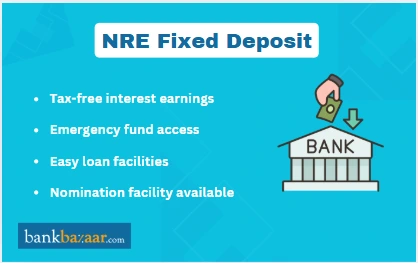
- Allows NRIs to open fixed deposits in India and earn impressive interest.
- They offer the depositors with ready funds when faced with an unforeseen circumstance as they can be closed prematurely.
- With banks providing overdraft and loan facilities NRE deposits ensure that the depositors can have money as and when they need it.
- The deposits offer nomination facility to the depositors
- NRE Fixed Deposits are insured by the DICGC up to Rs.5 lakh per depositor per bank, covering both principal and interest, the same as other bank deposits in India.
NRE deposits have certain benefits but they have certain drawbacks as well. One of the biggest drawbacks a senior citizen might face with NRE deposits is that the special interest rate for senior citizens on all other deposits is not applicable on NRE ones.
Difference Between NRE and NRO Accounts
Differences between NRE and NRO accounts:
NRE | NRO |
Deposits are tax free. | Deposits are not tax free. Any interest earned will lead to adequate TDS being deducted. |
You can deposit your foreign earnings in Indian denomination in this type of account. | You can deposit your Indian earnings in Indian currency in this type of account. |
You can easily transfer your principal amount and interest earned from your NRE account. | You can transfer up to $1 million from an NRO account. Beyond that, you'll need to pay applicable taxes before transferring the amount. |
Opt for this if you wish to keep your foreign earnings in Indian denomination and wish to keep it liquid. | This account is helpful if you wish to keep your Indian earnings in an Indian denomination. |
You can open this account with a close relative and another NRI only. | You can open this type of account with any resident in India and an NRI. |
Summary
An NRE Fixed Deposit remains one of the most reliable ways for NRIs to grow foreign earnings in India, offering interest that's tax-exempt in India (subject to FEMA residency status), full repatriability under RBI/FEMA rules, and flexible tenures from 1 to 10 years. Compare NRE Fixed Deposit rates across banks, check the eligibility and documents you will need, and pick a tenure that matches your goals before you invest.
FAQs on NRE Fixed Deposits
1.What is an NRE Fixed Deposit?
An NRE Fixed Deposit is a rupee term deposit that a Non-Resident Indian opens through an NRE account to invest foreign earnings in India. The principal and interest are freely repatriable under RBI/FEMA guidelines, and interest earned is exempt from tax in India for account holders who qualify as a person resident outside India under exchange control law.
2.What is the difference between an NRE and an NRO Fixed Deposit?
An NRE Fixed Deposit holds your foreign earnings and is fully tax-free and repatriable, while an NRO Fixed Deposit holds your Indian earnings and is taxable with transfer limits. Choose an NRE Fixed Deposit if you want to keep foreign income liquid in rupee terms.
3.What are the benefits of an NRE Fixed Deposit?
An NRE Fixed Deposit lets you earn tax-free, fully repatriable interest on your foreign earnings while offering premature closure and overdraft facilities for emergencies. It also comes with a nomination facility so your funds pass smoothly to your chosen nominee.
4.In which currency is an NRE Fixed Deposit held?
An NRE Fixed Deposit is held in Indian rupees, even though the money originates from your foreign earnings. The bank converts your foreign currency remittance into rupees when the deposit is booked.
5.What tenures are available for an NRE Fixed Deposit?
An NRE Fixed Deposit offers flexible tenures ranging from 1 year up to 10 years. You can choose the tenure that best matches your investment horizon.
6.Can an NRE Fixed Deposit be held jointly?
Yes, some banks allow an NRE Fixed Deposit to be held jointly with another NRI. Check with your chosen bank whether joint holding is permitted on its NRE Fixed Deposit.
7.Does an NRE Fixed Deposit auto-renew on maturity?
Many banks offer an auto-renewal facility on an NRE Fixed Deposit, so it renews itself once it matures. You can usually opt out of auto-renewal when you book the deposit.
8.Who is eligible to open an NRE Fixed Deposit?
Any Non-Resident Indian or Person of Indian Origin who holds an NRE account can open an NRE Fixed Deposit. You do not need to be a resident of India to apply.
9.What documents are required to open an NRE Fixed Deposit?
You typically need a valid passport, a valid work or residence visa, and address proof to open an NRE Fixed Deposit. Individual banks may ask for additional KYC documents.
10.How do I apply for an NRE Fixed Deposit?
You can apply for an NRE Fixed Deposit at your chosen bank's branch or through its NRI net banking or mobile app if you already hold an NRE account. You will need to submit your KYC documents as part of the application.
11.Can I take a loan against my NRE Fixed Deposit?
Yes, many banks let you take a loan or an overdraft against your NRE Fixed Deposit, with the exact loan-to-value limit set by your bank. This gives you access to funds without breaking the deposit.
12.Can I withdraw my NRE Fixed Deposit before maturity?
Yes, an NRE Fixed Deposit can usually be closed prematurely, giving you access to ready funds during an emergency. Premature withdrawal may attract a penalty as per your bank's terms.
13.Do senior citizens get a higher interest rate on NRE Fixed Deposits?
No, the special interest rate offered to resident senior citizens on other deposits does not apply to an NRE Fixed Deposit. This is one of the few drawbacks NRI senior citizens should keep in mind.
14.Do I have to pay tax on my NRE Fixed Deposit?
If you qualify as a person resident outside India under the exchange control law, the interest earned on your NRE Fixed Deposit is exempt from tax in India. This tax-free status is one of the main reasons NRIs choose NRE Fixed Deposits.
15.What will happen to my NRE Fixed Deposit if I return to India?
When you return to India, you can continue to maintain your NRE Fixed Deposit until it reaches maturity. You will typically need to convert or redesignate the account once you become a resident again.
16.What currencies can I use to fund an NRE Fixed Deposit account?
You can fund an NRE Fixed Deposit account with any convertible foreign currency. The bank converts the funds into Indian rupees when the deposit is opened.
17.Is the interest earned on an NRE Fixed Deposit repatriable?
Yes, both the interest earned and the principal amount on an NRE Fixed Deposit are fully repatriable. This makes it easy to move your money back abroad whenever you need to.

Disclaimer
Credit Card:
Credit Score:
Personal Loan:
Home Loan:
Fixed Deposit:


Copyright © 2026 BankBazaar.com.